
Unitree Go2 Air Quadruped Robot Dog Review
The Unitree Go2 Air delivers the core Go2 quadruped platform at the most accessible price in the lineup. Strong mobility, solid 4D LiDAR, and a proven mechanical design make it a compelling entry point for education and research — but the locked-down software limits its ceiling for serious development work.
Disclosure: DecisionWanted is reader-supported. We may earn a commission when you buy through our links. Learn more.
Reviewed Product
What Is the Unitree Go2 Air?
The Unitree Go2 Air is the base configuration of Unitree's second-generation consumer and research quadruped platform. It sits below the Go2 Pro in the lineup and is priced at $2,365 — making it one of the most affordable four-legged robots with a serious sensor suite available anywhere in the world. The Go2 family replaced the original Go1 in 2023 and introduced a fundamentally redesigned body, a new joint architecture, and the 4D LiDAR L2 as standard equipment across most variants.
The "Air" designation is Unitree's way of marking the entry-level configuration. Compared to the Go2 Pro ($3,790), the Air ships without the secondary development SDK that allows users to write custom motion controllers and perception pipelines. That single difference defines the entire purchase decision: if you need to program the robot at a low level, the Air is the wrong choice. If you need a capable, mobile, sensor-equipped platform for demonstrations, teleoperation, or structured educational exercises, the Air delivers the full Go2 hardware at a meaningful discount.
Design and Build Quality
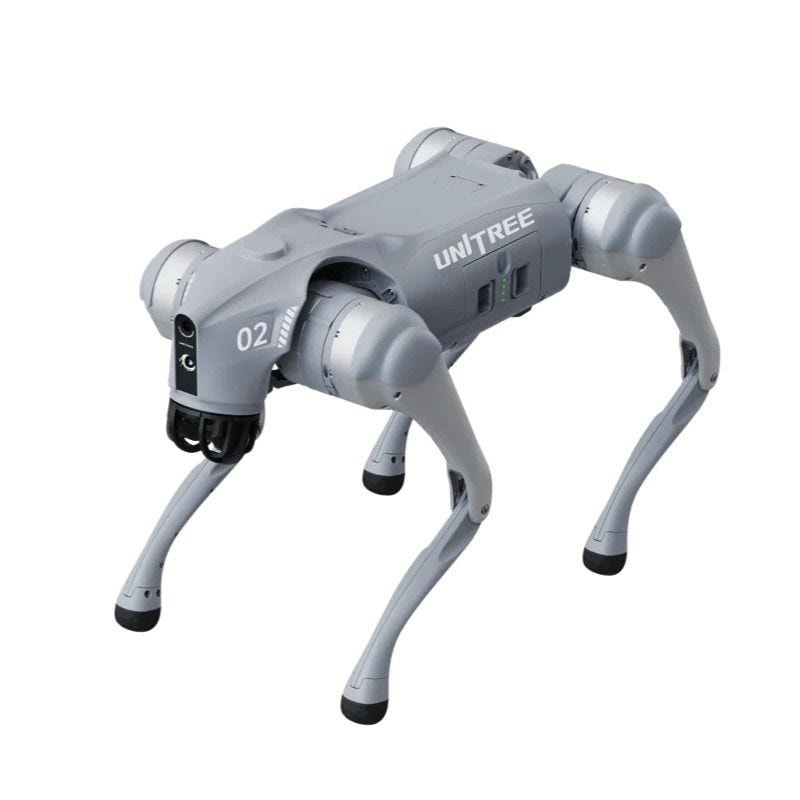
The Go2 Air inherits the same chassis as the rest of the Go2 family. The body measures approximately 70 x 31 x 40 cm in standing position and weighs around 15 kg with the battery installed. The design is compact and deliberately rounded — Unitree has moved away from the angular aesthetic of the Go1 toward a smoother, more consumer-friendly profile. The UNITREE logo and model number are embossed on the body panels, and the overall fit and finish is noticeably better than first-generation Unitree hardware.
The joint architecture uses Unitree's in-house actuators with a peak torque of approximately 45 N.m per joint. Each leg has three degrees of freedom — hip abduction/adduction, hip flexion/extension, and knee flexion/extension — giving the robot 12 actuated joints in total. The rubber feet provide reasonable grip on smooth indoor surfaces and light outdoor terrain. The robot handles stairs, slopes, and uneven ground well within its rated operating envelope.
Sensor Suite and Perception
The headline sensor on the Go2 is the 4D LiDAR L2, which provides 360-degree horizontal coverage and 96-degree vertical field of view. This is a genuine differentiator at this price point. Most quadrupeds in the sub-$5,000 range rely on depth cameras or basic 2D LiDAR; the Go2's 4D LiDAR gives it a much richer point cloud and enables more reliable obstacle avoidance in cluttered environments.
Connectivity covers Wi-Fi 6, Bluetooth, and 4G — the 4G option is particularly useful for field deployments where local network infrastructure is unavailable. The onboard compute handles the real-time motion control and basic perception tasks. The Go2 also includes a front-facing camera for visual feedback during teleoperation.
Software and Development
This is where the Air variant's limitations become concrete. The Go2 Air ships without the secondary development package that Unitree offers on the Pro and EDU variants. In practice, this means users cannot access the low-level motion control API, cannot deploy custom locomotion controllers, and cannot run their own perception pipelines on the onboard compute. The robot operates through Unitree's own app and a set of pre-programmed behaviors.
For a university lab running a robotics curriculum, or a company using the robot for demonstrations and teleoperation, this is an acceptable trade-off. For a research team that needs to implement novel gait algorithms or integrate custom sensor fusion, the Air is a dead end. Unitree is transparent about this distinction, and the price difference between Air and Pro reflects it accurately.
Payload and Runtime
The Go2 Air supports a payload of 10 kg — a figure that is officially documented and practically useful. A 10 kg payload budget covers most sensor packages, small manipulators, or additional compute modules that researchers might want to mount. Battery runtime is rated at 1 to 2 hours depending on gait, terrain, and payload. In practice, active use on varied terrain lands closer to the lower end of that range.
Who Should Buy the Go2 Air?
The Go2 Air makes sense for three buyer profiles. First, educational institutions that need a capable, durable quadruped for structured lab exercises and demonstrations — the pre-programmed behavior set is sufficient for most curriculum applications, and the hardware quality is well above what the price suggests. Second, companies evaluating legged robotics for inspection or teleoperation pilots, where the goal is to assess platform suitability before committing to a higher-spec configuration. Third, individual enthusiasts who want a serious quadruped for exploration and learning, and who are comfortable working within the constraints of the locked software stack.
Buyers who need to write custom controllers, deploy ROS2 packages, or integrate the robot into a larger autonomy stack should look at the Go2 Pro or the EDU variants. The price premium is real, but so is the capability gap.
Verdict
The Unitree Go2 Air is a well-built, capable quadruped at a price that would have been unthinkable five years ago. The 4D LiDAR, solid joint architecture, and 10 kg payload make it a genuinely useful platform for education and evaluation. The locked software stack is a real limitation, but it is an honest one — Unitree prices the development capability separately, and the Air is priced accordingly. For buyers who fit the target profile, it is one of the best-value quadrupeds on the market.
Pros
Cons
Editorial Verdict
The Go2 Air is the right choice for education, demonstrations, and evaluation pilots. It is the wrong choice for research teams that need low-level programming access. At $2,365 with 4D LiDAR included, it is one of the best-value quadrupeds available — within the constraints of its locked software stack.
Criteria Scores
Reviewed product
Go2 Air
Unitree Robotics
Discussion
Sign in to join the discussion
Create a free account or sign in to ask questions, share your experience, and engage with other readers.
Free · No spam · Cancel anytime
Have hands-on experience with this robot?
Write your own review — community reviews are editorial-checked and published alongside expert assessments.