
UBTECH Walker C Review: Commercial Reception Humanoid
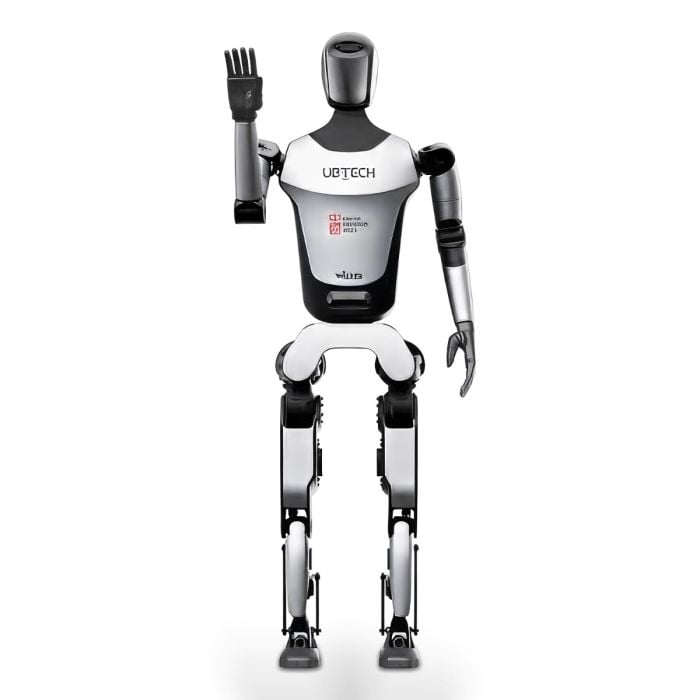
The UBTECH Walker C is a 163 cm, 43 kg bipedal commercial humanoid designed for reception, guided tours and venue engagement. Its standout assets are natural-height presence, expressive 20-DOF movement and a documented indoor perception stack; its modest duty cycle and integration burden keep it from being a general-purpose service worker.
Disclosure: DecisionWanted is reader-supported. We may earn a commission when you buy through our links. Learn more.

Reviewed Product
What the UBTECH Walker C is
The UBTECH Walker C is a full-size electric bipedal humanoid for front-of-house work. It is not a factory humanoid, a delivery robot or a general-purpose manipulator. Its stated role is public-facing reception, guided tours, visitor interaction and event activation in indoor commercial venues. At 163 cm tall, it meets guests at a natural conversational height; at 43 kg, it is substantially lighter than many industrial humanoids, reflecting a design priority of operating around people rather than moving heavy objects.
That positioning matters to a procurement decision. A walking humanoid can make an entrance, lead a group and add physical presence to a scripted experience in ways that a wheeled kiosk cannot. But a venue should buy Walker C for a repeatable service flow—welcome, route guidance, exhibit narration or multilingual visitor engagement—not as a catch-all substitute for a receptionist, guide or facilities team.
Mobility and physical platform
The published configuration has 20 degrees of freedom and a quoted top walking speed of 6 km/h. The figure suggests the robot can keep pace with a casual walking tour, but it is not a guarantee of safe average speed in a busy public environment. Route geometry, pedestrian density, floor transitions and the organisation’s own safety rules will determine the operational setting. Buyers should plan for conservative speeds and designated routes during early deployment.
Walker C is specified with 500 mm arm span and 5 kg arms. These details point to gesturing and social expression rather than payload work. The arms may make narration and greetings feel more legible, but the published material does not establish a rated payload, dexterous hand capability or a task-certified manipulation workflow. It should not be purchased on an assumption that it can pick, carry or operate everyday infrastructure.
Perception, navigation and interaction
UBTECH lists two RGB-D cameras, two binocular structured-light 3D cameras and a high-precision IMU. In principle, that is a credible depth-sensing stack for indoor obstacle awareness, person-facing interaction and map-based navigation. U-SLAM is named as the navigation method, with autonomous path planning and semantic 3D mapping. These are documented platform capabilities, not an independent validation of behaviour in every venue.
For interaction, Walker C is described as using UBTECH’s Embodied Interactive Large Model for multilingual dialogue, interactive Q&A, broadcasting and AI storytelling. This makes it more than a motion prop, but the decisive work remains local: teams need approved knowledge, clear escalation rules, language coverage, privacy guidance and staff who can recover a stalled interaction. No public specification supplied for this model should be treated as a promise of factual accuracy, unrestricted dialogue or autonomous customer-service resolution.
Battery planning is the operational constraint
The listed battery is 48 V, 15 Ah. Published estimates are around two hours of walking duty or four hours of standing service, with roughly 1.5 hours to charge. Those figures are useful for initial capacity planning but are not a full-shift runtime claim. Walking, displays, speech, wireless networking, thermal conditions and interaction frequency all influence actual endurance. A single robot will need tightly scheduled tours, handoff moments or a charging plan; high-traffic operations should evaluate fleet coverage and service continuity rather than treating one unit as an all-day reception desk.
Where it makes sense
Museums, exhibition halls, corporate visitor centres, showrooms and high-visibility hospitality venues are the clearest fit. In these settings, a controlled route and curated narrative can turn the robot’s form factor into a useful part of the experience. The documented Expo 2025 Osaka China Pavilion deployment is relevant as evidence that the robot has been presented in an international public-tour context, though every new site still needs its own safety and workflow validation.
It is a weaker fit for crowded, constantly reconfigured lobbies, long unattended shifts, freight handling, outdoor duty and any situation where the business case depends on replacing human judgment. A wheeled service platform may be the more practical choice when uptime, runtime and predictable routing matter more than humanoid presence.
Deployment checklist
Before procurement, conduct an on-site route survey with real footfall conditions, ramps, glass, reflective surfaces, thresholds and evacuation routes. Run acceptance testing for stopping behaviour, recovery from blocked paths, speech intelligibility, network loss and handoff to staff. Establish ownership for content, map updates, battery charging, incident response and software access. Finally, measure outcomes—tour completion, wait times, visitor satisfaction and staff interventions—rather than relying on attention generated by the robot itself.
Verdict
Walker C is a specialized commercial humanoid with a more coherent purpose than many headline-driven bipedal robots. The documented dimensions, 20-DOF body, depth cameras and mapping stack support a plausible reception and tour-guidance role, while its short published walking runtime and incomplete public detail around manipulation and service-level performance require caution. The 3.8/5 score reflects a compelling experiential platform for prepared venues, not a turnkey autonomous employee.
Pros
Cons
Editorial Verdict
The Walker C is a credible, specialized humanoid for scripted reception and guided-visitor work. It earns its value through well-run tours, exhibition narration and brand-facing service—not through claims of general-purpose autonomy. Buyers should validate runtime, route safety, dialogue quality and staff intervention rates on site before treating it as a scalable service solution.
Criteria Scores
Reviewed product
UBTECH Walker C
UBTECH
Discussion
Sign in to join the discussion
Create a free account or sign in to ask questions, share your experience, and engage with other readers.
Free · No spam · Cancel anytime
Have hands-on experience with this robot?
Write your own review — community reviews are editorial-checked and published alongside expert assessments.